Wednesday, October 22, 2008

Saddle Butte Lake v. West Crater Lake

On my last field trip, I collected high precision GPS points on the highest evidence of overflow that I could find on each likely lava dam. In the case of the Saddle Butte lava dam (SBLD), there is evidence of shallow overflow over most of the extant dam crest...I had not realized this before. There are some photos of this in the recent album I posted. The highest overflow evidence was at 1044m (3425 ft). As for West Crater, the elevation of the first evidence for overflow (rounded basalt cobbles on the extant flow margin) is found at 1029 m (3375 ft)(*note that this is reported incorrectly in the figure caption). There is not nearly as clear a lava dam edifice here as there is at Saddle Butte, you may recall.

For what it is worth, the difference is more than expected or could be read from a topo map. As the figure indicates, a 15 m difference in depth has a locally significant effect on the extent of the lake. This is based, or course, on modern topography.

Thermodisappointmence commentary

Figure showing extent of possible lake above West Crater lava dam

Minding and (yes) chuckling about the technology gap, I have added some recent commentary from Yeehow Principals about the OSL results (see below).

I am leaning toward analytical or sample problems based in part on other OSL experiences, but admit that Jim's ideas hadn't occurred to me. I will mull them over. It is notable that the lake would have been fairly large and it may have taken sediment a long time to make it to the dam itself.

Kyle,
Can't blog on the site because I can't remember my user name or password or some such immense Luddite hurdle.
But my immediate thought (assuming that 22ka isn't just the standard OSL result) is that the lake (and its deposits) might owe to changing basin hydrologic characteristics rather than the timing of the blockage. Perhaps the blockage was not sealed sufficiently to form a lake until things got much wetter during the maximum of the last glacial. Or alternatively, significant sediment didn't accumulate until then in a lake that did date back to initial blockage. And recall that when the Alvord basin was full and spilling (at least for several hundred years) at some point loosely around this time during last glacial, there would have been a lot more water coming down the Owyhee from the expanded source area. This could be another twist on the story...
Perhaps the Crooked Creek flood triggered incision (would the terraces ages at Dog Leg jibe with that?).

I'll check on the tephra situation--I have many more samples that have been sitting there even longer. As I said when you sent them my way, you get what you pay for, and when you don't pay anything it's hard to whine.
...Jim

Yeehows,

Sorry, Kyle. I tried to post a comment to the blog, I really did. Same
luddite excuse as Jim. I seem to have set up multiple accounts with
multiple passwords and the matrix of possible matches is too much for me.

I've thought a lot about these OSL results. It's possible that the lowest
deposits are related to a landslide dam downstream, but highly unlikely
that the others are. The deposits on river left can be directly traced up
to the rim on top of the Saddle Butte. Any landslide that blocked the
river that high would have been close to the height of the West Crater dam
itself. I haven't been to the higher site on river left, but it looks like
it is on top of the WC lava itself. Jim's ideas are worth considering, but
my hunch is that something went wrong with the OSL dating itself. The
fine-grained samples we have to work with are not ideal. These ages are at
least 20,000 years younger than the youngest date on the West Crater flow,
and 40ka younger than our best estimate.

Caitlin has started reading up on OSL and the possible reasons behind
erroneous dates, especially those that are younger than the true age.
Next week, after we've discussed this at our Bend summit, I'll contact
Tammy with some specific questions about possible sources of problems with
these results and get her take on them. I have submitted additional OSL
samples from Sand Spring, behind Saddle Butte II flow (could also be
backed up from West Crater), 2 more samples from top and base and middle
of same WC section on river left, and one from sediments way up on rim
behind Bogus Rim flow. We'll see what comes of those. Should shed some
light on the issue, as some of them should be from older damming episodes.

Lisa

Tuesday, October 21, 2008

Back to the Bogus Lake


Here is a more detailed example of how large a lake dammed by the Bogus Rim lava would have been. This image assumes a dam at Iron Point with a crest elevation of 1200 meters. Made in a flash with GlobalMapper.

OSL Results....Thermodisappointmence?

Before my last field outing, I contacted the USU OSL lab about our samples. The good news: preliminary data are available. The bad news: wtf do they mean?

From: *Tammy Rittenour* <tammy.rittenour@usu.edu
tammy.rittenour@usu.edu>>
Date: Tue, Sep 30, 2008 at 3:03 PM
Subject: RE: Owyhee OSL?
To: Kyle House <pkhouse@gmail.com pkhouse@gmail.com>>

Kyle-

Ive attached the preliminary results from your Owyhee River samples.
They are about 75% complete at this moment. I am working on sending
them in for further processing because of some initial feldspar
contamination, but you should have the final results by the end of the
month.

The samples are all ~22-23ka, if they were taken from the same deposit,

then OSL seems to be working quite well.

Errors on the ages will go down when they are completed, but I dont
expect them to change much at all.

Good luck in the field,

Tammy

What do we make of this information? Well. We suspected that these lacustrine seds were related to damming by the West Crater flow. Given their distribution with respect to the upstream face of that flow this seems like a valid assumption. However, these ages are far younger than the likely age of the West Crater flow. That is a problem. Also, the samples cover a large range of elevation. I expected that there would possibly be a correlation between the elevation of the sample below the likely dam and its age. This is not the case. Check the figure below for a visual cross-check:This figure is a profile from the 10 m DEM data. The profile hits the four sample spots in the area. The geology is schematic (obviously) and hastily drawn (more obviouslyer).


Note the large elevation range of the three sample areas*. Each sample is denoted by a yellow circle (excpet the highest circle, that is a gravel deposit that wasn't sampled). We are still awaiting an identification of an obvious tephra bed that was sampled below the lowest OSL sample. Sent that (and all others) to WSU in early August....USGS has been sitting on it for over a year. If that comes back with a confident ID, then we will have some additional perspective on the OSL data. Any thoughts? Break down and add to the blog....

*I have wondered aloud on numerous occassions about the lowest one...possibly related to landslide dam? Its elevation is pretty low relative to the sublava paleochannel of Ryegrass Creek. The paleotopography implied by this (if related to West Crater) is pretty deep.

Monday, October 20, 2008

Topo Profiles in Study Area

I whipped up these images while revisiting the mapping in earnest today. These can be made in seconds using GlobalMapper. All offer some insights and are interesting to consider. We need to choose some key ones to illustrate with stratigraphy etc. If you lose your bearings, just click to go to the online album and check the map.

Monday, October 13, 2008

Precision GPS Data from Dogleg Bend

Last week, I spent some time collecting presumably high-precision GPS data with my new Trimble GeoXH unit. The first dataset that I have corrected is from Dogleg. Now we have some pretty robust numbers for incision rate calculations.

Grand Yeehow challenge. Someone out there break down and do the calculations. Post it to the blog and ruminate on it. My guess is that it will be sort of high.

Friday, September 5, 2008

Compelling evidence for lava-dam failure in Grand Canyon

As I noted earlier, there are some pretty clear indications for linkages between lava dams and large floods on the Colorado River in Grand Canyon that stand in contrast to what we see on the Owyhee. One particularly interesting morpho-stratgraphic association includes the following assemblage:

  1. Lava flow on river gravel; no evidence for water interaction other than flowing down the channel.
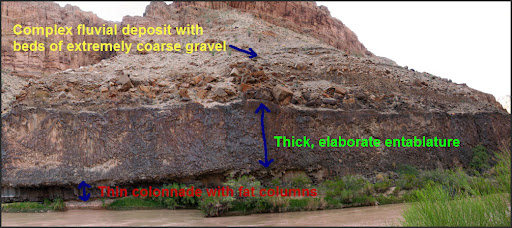
  2. Flagrant flow morphology characterized by relatively thin colonnade (with very fat columns in the example below) overlain by considerably thicker entablature.
  3. Coarse-grained, complex fluvial deposit containing abundant reworked lava and hyaloclastite material.

Here is a 'Grand' example from mile 192:


What might be going on here? Well, following some discussion with Ryan Crow and some reading about entablature formation that he recommended, I think that this assemblage permits the following interpretation:
  1. Lava flow enters canyon and blocks river, allowing flow to continue unimpeded downstream (lava on gravel with no evidence for lava-water interaction)
  2. Clear water begins to pass over or through the dam (or both) and greatly accelerates cooling of the lava (induces the elaborate and thick entablature structure)
  3. Dam eventually (soon) fails catastrophically and coarse gravel is deposited on the lava flow that now forms the bed of the river.
The overlying gravel deposit in this case is notable for the large blocks of poorly rounded colluvial gravel that it contains. That appears to be a common characteristic of these flood deposits. Some likely reasons include: elevation of the channel bed and conveyance of deep high velocity flow at stages not typical of the pre-lava dam river. It is also reasonable to expect that the demise of the dam may have occurred at the buttress of lava on colluvium. I am certain that Cassie suggested this in one or more papers.

With respect to the distinct morphology of the cooling structure of the lava flow, it seems almost inevitable that the very thick and elaborate colonnade reflects the influence of rapid cooling of the lava flow by a very large volume of water. In this case, I am inferring that this huge amount of water is the continuous, initially clear flow of the Colorado around, over, or through the dam. It is also notable that the overlying deposit is multi-phased. There are several beds and only some are extremely coarse. The sequence may contain evidence for the progressive failure of the dam and other vagaries of the hydrograph.

It would be interesting to know if there was any evidence that the gravels were deposited on a cooling lava flow...maybe there are some key erosional forms to look for. Didn't think of that at the time.

This seems like a strong case for failure of a lava dam. There are no assemblages like this on the Owyhee River.

Check this abstract for a discussion of the role of water in forming the colonnade:

Here are some other articles of interest (from a longer list compiled in 5 minutes using Zotero)


Grossenbacher, K. A., and S. M. McDuffie. “Conductive cooling of lava: columnar joint diameter and stria width as functions of cooling rate and thermal gradient.” Journal of Volcanology and Geothermal Research 69, no. 1-2 (1995): 95-103.

Long, P. E., and B. J. Wood. “Structures, textures, and cooling histories of Columbia River Basalt flows.” Bulletin of the Geological Society of America 97, no. 9 (1986): 1144-1155.

Lyle, P. The eruption environment of multi-tiered columnar basalt lava flows. Vol. 157. Geological Soc London, 2000.

Walker, G. P. L. “Basaltic-volcano systems.” Geological Society London Special Publications 76, no. 1 (1993): 3.

Friday, August 29, 2008

GC vs Owyhee

Dr. Jerque,

In a rare moment of 9-5 nonbillable geology work I submit:

The four observations you list (added below in italics) as some of the differences between the Owyhee and GC intra-canyon lava dams are some of the exact same ones I note in the manuscript that is collecting dust on my desk at home.
1. Volume of lava vs. volume of water
2. Mode of entry: canyon rim cascade vs. tributary valley route

3. Severity of topography (vertical and lateral trajectory of lava incursion)

4. Proximity of volcanic vent to the canyon; abundance of pyroclastic material.
This is fabulous! I look forward to hearing more about these items and your other GC observations.
-Spud


Best Owyhee example of lava dam features


The Sand Springs Wash area on the Owyhee retains the best example of a lava dam in the field area. At this site, there are two lava flows from the Saddle Butte vent to the west. The overlying flow is separated from the underlying flow by a spectacularly well-developed lava delta with pillow-laden foresets that dip upvalley. The dam forebay is a turtle-back like feature with a 'carapace' of chilled lava. The surface of the older Saddle Butte lava upstream of the dam is covered with lacustrine mud which is capped with fluvial gravel.

Upstream of this site, the older Saddle Butte lava flow overlies Owyhee River gravel at the site of the Weeping Wall where a spring issues from the contact between the gravel and the lava. Upstream of Weeping Wall, the older Saddle Butte lava contains a sequence of lava deltas and subaerial lavas that suggest a complex interaction with the river.

Downstream, the eastern margin of the younger Saddle Butte flow is wasting away on a grand scale.

First insights from the Grand Canyon


Probably the most striking aspect of my recent trip down the Grand Canyon is the stark contrasts of the intracanyon lava flows and related response of the river there with those of the Owyhee.
  • The lava stratigraphy in the GC is notably more complicated than the Owyhee.
  • In GC the variability in lava textures and the facies variability of related volcaniclastic deposits is much greater. Some GC volcaniclastic deposits are downright bizarre looking to me.
  • In several circumstances, there is strong evidence supporting the occurrence of catastrophic flooding in conjunction with the incursion of lava into the Grand Canyon (note photo above); whereas on the Owyhee, there is no clear evidence of this.
  • In GC, there are few to no really good examples of lava deltas. The Owyhee has world class examples.
  • In GC, the intracanyon flows are not associated with large-scale (post-emplacement) mass wasting processes. The Owyhee has some spectacular post-emplacement landsliding of lava flow remnants and, thus, continue to plague the river for 1000s of years.
Bottom line is that there is great evidence in the Grand Canyon for lava dam failure and related catastrophic flooding. There is weak to no evidence in the Grand Canyon for effective, relatively long-lived damming of the river. In contrast, there is weak to no evidence on the Owyhee River to support catastrophic flooding related to lava dams. There is great evidence on the Owyhee that substantiates effective, relatively long-lived damming of the river by lava.

Obvious questions: Why the profound differences? Why is the Owyhee so much easier to dam with lava than the Colorado?


1. Volume of lava vs. volume of water
2. Mode of entry: canyon rim cascade vs. tributary valley route
3. Severity of topography (vertical and lateral trajectory of lava incursion)
4. Proximity of volcanic vent to the canyon; abundance of pyroclastic material.

I am pretty sure it involves aspect of each of these factors. Stay tuned for more maunderings and some more details on the points above.

Tuesday, August 26, 2008

SHRIMP in the Owyhee?? Fire up the barbee mate!

Dear Dr. Froude et al.:

I concur with Dr. Jerque. He refers to a plethora of field evidence that adds detail to the story presented in Ninad's work. I'd like to add that you may want to check out a paper from the Idaho State crowd of Beranek, Link, and Fanning (see below). This paper came out some time back and offers a few possible numbers for ages of big picture events in the region. If I recall correctly, the most Owyhee-relevant discussion items are based on only a few data points compared to other drainages studied and could be strengthened by additional analyses. Nontheless, it is pretty darn interesting to this spud farmer trapped in the concrete jungle.


-Spud

P.S. Dr. Jerque: I think we are on the same page about the Rytuba and Vander Meulen work. I did overstate its relevance in reference to the Now Voluminous (Once Dreaded) Rim Gravels but refer to it merely in the context that it provides evidence of a long-occurring interaction between volcanism, the fluvial system, and expansive sedimentation in the region. I wonder if it is even relevant to the latest question because "The inital influx of major fluvial systems into the volcanic field after about 14.5 Ma is reflected...."(see abstract)?

How old is the Owyhee?

Today, Dr. Froude presented the most basic question: How old is the Owyhee River. I pulled some stuff out of the air in a quick response, and ultimately claimed the river developed between about 5-8 Ma and 1.8 Ma. I decided my response was too quick, and too poorly founded, so I started looking for some of Ninad's data. Turns out that Miami Univ puts all of their dissertations online. Very handy. Thus, I present some of Ninad's dissertation below to serve as a reference point for all of us. By combining his data with our collective field observations, I think we can answer the question. For the sake of completeness, here is my response to Froude's query:

Bogus Rim flow and underlying flows fill a surprisingly deep paleovalley that runs along the alignment of the modern canyon below iron point. Gravels are present at the base of the sequence in a few places (including possibly in the Owyhee Breaks area) and there are erosional intervals preserved between some of the flows. Not sure how well constrained the ages of the lowest flow (the 'lower Bogus lavas') are, but somewhere between 5 and 8 comes to mind (without looking anything up). There was a river flowing north before the Bogus lavas were emplaced. This river created the paleotopography in the Grassy Mountain Rhyolite and sediments before the first big barf of basalt flowed north. Based on the thickness of the Bogus Lavas in the Rinehart Canyon area, there were some deeply incised tributaries flowing into the river.

In terms of field evidence, the biggest influx of gravel occurs in conjunction with the end of the damming event caused by the Bogus Rim flow. I believe that evidence is mounting that a very large lake occupied the area upstream of where the Bogus Rim flow would have created a dam somewhere near Iron Point. Thus, the pre Bogus Rim river was probably a nearly full blown Owyhee. Possibly the full blown river developed in conjunction with surmounting the Bogus Rim dam? That should have been sometime after about 1.8 Ma. I recently collected a tephra from the lake sediments that I postulate were deposited into a Bogus Rim dammed lake. Dating that may be of some value.


Here is the geochronology from our area as reported by Ninad Bondre:
Here is a nifty map that places these data in a better context:
Also, Ninad's thesis includes a handy little geologic map:

Some thoughts:

Despite the geochronology, I am thinking that the Owyhee Butte lava must predate the Bogus Bench lava. Field relations suggest that the gravel that pervasively overlies the Owyhee Butte lava is related to damming of the Owyhee River by the Bogus Bench (Rim) lava. I have not seen any gravel below the Owyhee Butte lava (forms the Artillery Rim), but Liz and I noted in July that there are hyaloclastite units in the upper parts of this package. Note also that the Bogus Bench (Rim...Brim?) lava has no gravel on top until you get a few km downstream from Iron Point. There, you find a 5-8 m thick deposit of locally derived, but rounded gravels. (I have shown pictures of this before in a previous post, but may add them again soon for emphasis). We know from multiple locations that the Bogus Rim lava flowed down a channel of the Owyhee River and overlies rounded gravel in various places. The local gravel pile likely relates to decommissioning of the dam.
Thus, the river is at least 1.92 Ma old. Note that the 4569 vent has a date of approximately 5.64 Ma. The one-sided plateau morphology of that vent and flow complex supports the idea that it formed a lake on its south side, much like Bogus Bench. However, I have not seen (nor looked hard for) gravel. My hunch is that this may be related to a precursor drainage. Speculative.
My preliminary conclusion is that the river formed between 5.6 and 1.92 Ma, probably closer to 1.92. Any thoughts?

All figures and the table in this post taken from:

Bondre, N.R., 2006, Field and geochemical investigation of basaltic magmatism in the western United States and India. PhD. Dissertation, Miami University, Miami, OH., 252 p.

http://www.ohiolink.edu/etd/send-pdf.cgi/Bondre%20Ninad%20R.pdf?miami1164916380

Monday, August 4, 2008

Grand Hiatus for Dr Jerque

Fellow Yeehows. Unfortunately I will be spending the next three weeks slogging through the Grand Canyon with various experts on its geology. Special attention will be given to lava flows, lava dams(?), and all sorts of other things. I am hiking down to Phantom Ranch on Wednesday morning with a pack full of all the stuff I forgot to send ahead. Of special note is a new 10 MP Pentax camera that is waterproof and dustproof. This way I hope to get some fearless shots from the river. Recently took it to Tahoe to try it out:


I will certainly provide a synopsis when I return.

Tuesday, July 29, 2008

What's up with upper-tier landslides?

After looking at landslide after landslide along the Owyhee, it is pretty clear that there are several modes of failure typical of the river corridor. Of course we have the basic earthflow type (the Hole in the Ground has great examples); the basic rotational slump type (Artillery landslide complex; Heaven's Gate landslide complex); and the basic cantilever slab type failures along the margins of the Quaternary intracanyon lava flows. Yes, there are complex combinations of all of these things as well. Recently, Liz and I were noting that there are areas where only the upper part of an exposued section is peeling away...this is particularly true in areas where there are stacks of massive lavas with occassional interbeds of lacustrine sediments or, more importantly, piles of lava-water interaction deposits. The Bullseye landslide in 'Sweetwater Canyon' (name from river guidebook) is a good example. There, the upper lava flow is peeling back across a cruddy looking bed of lava-water interaction deposits (LWID). The LWIDs overlie a relatively massive stack of lavas. It appears that the Bullseye landslide's head scarp is below the peeling section. Its ultimate failure would not have been possible without the peeling in the upper tiers of the section. This makes Bullseye a lower-tier slide candidate.


There are lots of examples of upper-tier sliding along the river. Possibly the most impressive is right across from Iron Point. In that case, the failing area is pinned on rhyolite. There are several landslides in this general reach that sole-out on rhyolite. Not sure whether they occurred when the river was at the level or if they freaking cascading over the rhyolite into the river. Probably the former since the latter sounds so cool.


There are many examples where the upper-tier sliding seems to be associated with an underlying LWID (like a lava delta) or otherwise incompetent unit (like a lens of mud). In some places, the lava deltas are obviously linked to massive landlsiding; in others, they support massive cliffs. Maybe when you peel away the top, they lead to massive landslides. Probably not that simple. Any thoughts? Anyone?

Is the Bogus Lake bogus?

Check out the extent of a lake with surface elevation of 3900'...


Shockingly Voluminous (Once Dreaded) Rim Gravel, redux

Alas, brother spud, unless we are on different conceptual planes here, the paper in question does not directly address the SV(OD)RG. Instead, it is focused on the fluvial sediments in the middle Miocene part of the section, specifically the arkosic sandstone and mudstones that we see interbedded with rhyolite just downstream from AM-PM camp:


In the context of our studies, this part of the record is only a glimpse into an ancient precursor drainage system. In fact, I think that a fair amount of the SV(OD)RG in our study area is related to lava damming events in the latest(?) Miocene and into the Pliocene (i.e. the Bogus Rim).Thus, is is possible that the SV(OD)RG represent blockage of an integrated / partially integrated Owyhee. Recall that the base of the Bogus lava sits on river gravel in various places between Iron Point and Birch Creek. I suspect it was the blockage of this system in the early Pliocene to late Miocene(?) that deposited the gravels that form a flat surface at 3900'. Subsequent and possibly sporadic incision through the gravel cover after the breach formed several discernible levels of gravel. This is directly analogous to the distribution of the much less widespread and voluminous gravels above the Quaternary blockages. It is that latter point that really pulls me in. Any counter arguments? Anyone?

In the figure below, I have pointed out some features of the gravel. I have approximated its MINIMUM extent using the snow-like pattern. Have also noted the problem with the Ice Axe as Bogus Rim (stay tuned for explanatory post on that one). This is a crude mock-up. A more formal figure will be forthcoming with lots of elevation data...(just got me a Trimble XH...arrived today!).

(click on image for full size)

Monday, July 28, 2008

Reference related to the "Shockingly Voluminous" Rim Gravel

Hi Folks:

Here is a reference from my thesis that a very nice man (who once offered me a job in mineral exploration) turned me on to:
Rytuba, James J., and Vander Meulen, Dean B., 1991, Hot-Spring Precious
Metal Systems in the Lake Owyhee Volcanic Field, Oregon-Idaho;
in Raines, G.L., et al., 1991, Geology and Ore Deposits of the Great Basin,
Symposium Proceedings, USGS and Geological Society Nevada, Reno, Nevada,
Volume II, pp. 1085-1096.
If I remember correctly, I think it is pretty relevant to the dreadfully voluminous rim gravel and provides some corroboration of some of the things Dr. Jerque and others are finding in the field. Dr. Jerque may have a copy and I can scan you a copy sometime if you can't find it.